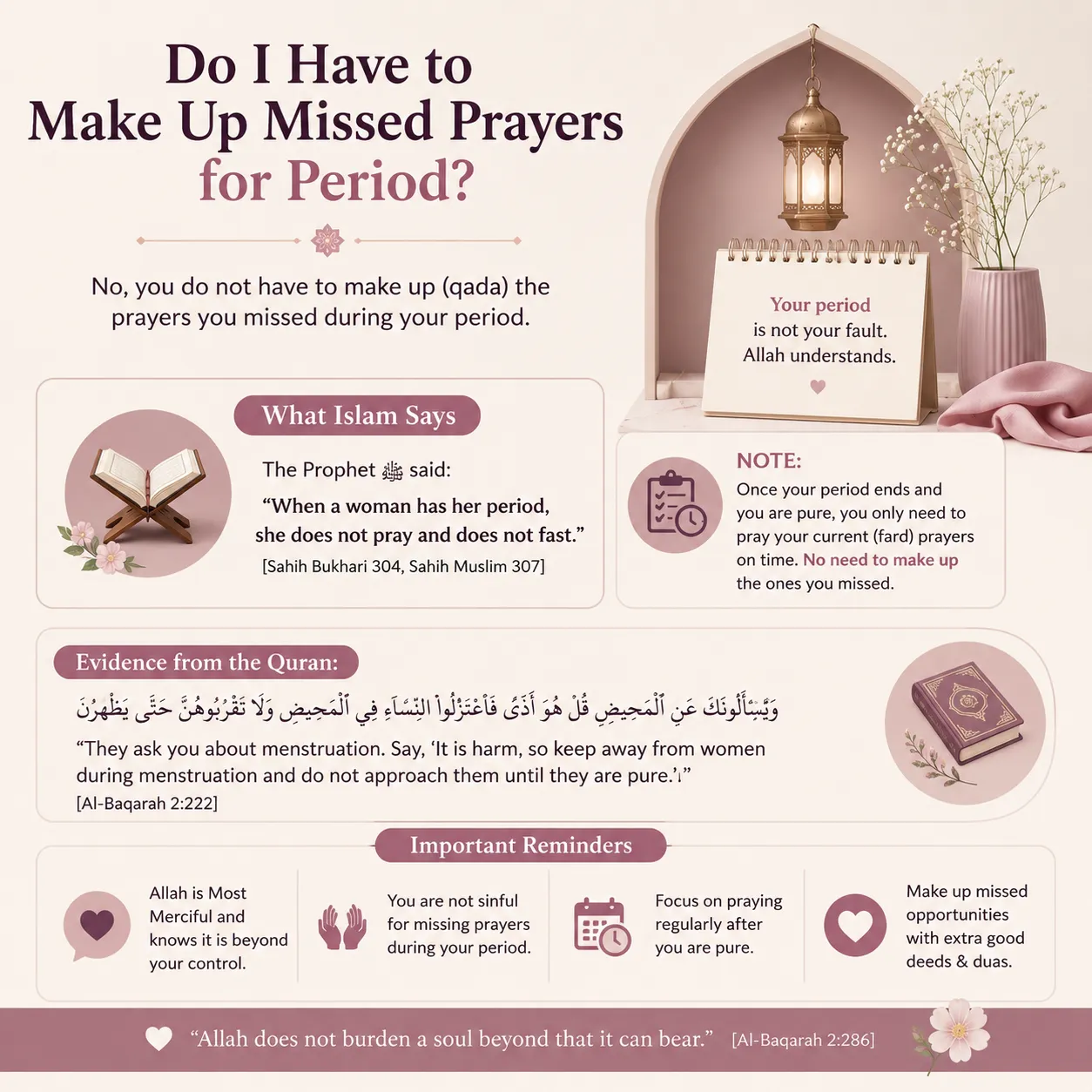
Many Muslim women carry unnecessary guilt about prayers missed during menstruation, but Islamic teachings offer a clear and merciful answer.
I remember speaking with a young Muslim woman who felt a weight on her shoulders every month. She worried that the prayers she missed during her period were somehow accumulating into a spiritual debt she would have to repay later.
If you’ve ever asked yourself, “do I have to make up missed prayers for period?”, you’re not alone. It is one of the most common questions Muslim women ask, especially when they sincerely want to please Allah and stay faithful in their worship.
The beautiful reality is that Islam is a religion of mercy, not hardship. Menstruation is a natural condition created by Allah, and the guidance surrounding it reflects His compassion.
By understanding the ruling correctly, many women find freedom from guilt and greater confidence in their relationship with Allah.
Do I Have to Make Up Missed Prayers for Period?
The short answer is no.
According to the overwhelming consensus of Islamic scholars, a woman does not make up the obligatory prayers she misses while menstruating.
This ruling comes directly from authentic Islamic teachings. During the time of the Prophet Muhammad ﷺ, women experienced menstruation just as women do today. When they became pure again, they were instructed to resume prayer, but they were not required to perform all the missed prayers from their menstrual days.
This is an important distinction because Islam differentiates between missed prayers due to menstruation and missed prayers for other reasons.
Menstruation is not considered a sin, a failure, or negligence. It is a natural state in which certain acts of worship are temporarily lifted.
Rather than viewing this time as spiritual distance, many scholars encourage women to see it as a period of worship in different forms, such as remembrance of Allah, supplication, reflection, charity, and seeking knowledge.
Why Islam Does Not Require Missed Prayers to Be Made Up
At first glance, some people wonder why fasting during Ramadan must be made up later, while prayers do not.
The answer lies in divine wisdom.
Five daily prayers occur every day throughout the year. If women had to make up every prayer missed during every menstrual cycle, the burden would become immense over a lifetime.
Islam removes unnecessary hardship.
The religion recognizes human realities and provides rulings that balance devotion with mercy.
This ruling also reminds believers that worship is not merely about performing actions. It is about obeying Allah as He instructed. Sometimes obedience means praying. At other times, obedience means accepting the concession Allah has given.
What About Missed Fasts During Menstruation?
This is where some confusion arises.
While missed prayers are not made up, missed Ramadan fasts are made up after menstruation ends.
This distinction is based on authentic narrations from the companions of the Prophet ﷺ.
The practical result is simple:
- Missed daily prayers during menstruation: No makeup required
- Missed Ramadan fasts during menstruation: Must be made up later
Many women mistakenly assume both rulings are the same, but Islamic law treats them differently.
Common Feelings Women Experience
Feeling Guilty
Some women feel disconnected from worship during their period.
Yet the absence of prayer during menstruation is not disobedience. In fact, refraining from prayer during this time is itself following Allah’s command.
Feeling Spiritually Distant
It can be difficult to pause a routine that brings comfort and peace.
However, spiritual connection does not disappear simply because formal prayer is temporarily suspended.
You can still:
- Make dhikr (remembrance of Allah)
- Listen to beneficial Islamic lectures
- Send blessings upon the Prophet ﷺ
- Make sincere du’a
- Reflect on Allah’s blessings
- Give charity
Feeling Behind Others
Seeing family members continue their prayer routine while you cannot participate may create feelings of being left behind.
Remember that Allah judges people according to their circumstances. A woman following the rules of menstruation is not losing reward by obeying Him.
What Should I Do When My Period Ends?
Once menstruation has completely finished and purity has returned, a woman should:
- Perform ghusl (ritual purification).
- Resume the next prayer at its proper time.
- Continue her normal worship routine.
- Make up any Ramadan fasts missed during the cycle when appropriate.
There is no requirement to create a schedule of missed prayers from the menstrual days.
There is also no need to feel anxiety about “catching up” on prayers that Islamic law never required you to perform during that period.
Different Scholarly Opinions
Among the major schools of Islamic jurisprudence, the established and widely accepted view is that menstrual prayers do not need to be made up.
This position is supported by generations of scholars and is rooted in authentic prophetic guidance.
While you may occasionally encounter discussions online that create confusion, the mainstream scholarly position remains clear: missed prayers during menstruation are excused and do not require makeup.
If you have unusual circumstances or ongoing uncertainty, consulting a qualified local scholar can provide personal guidance.
Practical Ways to Stay Connected to Allah During Your Period
Many women find comfort in creating a special worship routine for this time of the month.
Some ideas include:
- Setting aside time for du’a each day.
- Reading Islamic books.
- Listening to Qur’an recitation.
- Reflecting on personal goals and gratitude.
- Increasing remembrance phrases such as SubhanAllah, Alhamdulillah, and Allahu Akbar.
- Making sincere repentance and seeking closeness to Allah.
These practices can transform menstruation from a period of frustration into a period of spiritual growth.
Frequently Asked Questions
Do I have to make up missed prayers for period?
No. The missed obligatory prayers during menstruation do not need to be made up after purification.
What if I missed prayers because I thought I had to wait longer after my period ended?
If the delay occurred after you had become pure and prayer had become obligatory again, you should consult a knowledgeable scholar regarding your specific situation.
Do I make up voluntary prayers?
Voluntary prayers missed during menstruation are generally not required to be made up.
Why are missed fasts made up but not prayers?
Islamic teachings specifically instruct women to make up missed Ramadan fasts while exempting them from making up missed prayers.
Am I sinful for not praying during my period?
No. Menstruation is a divinely recognized exemption. Refraining from prayer during that time is part of following Islamic guidance.
Final Thoughts on Do I Have to Make Up Missed Prayers for Period
If you’ve been carrying worry, guilt, or uncertainty about this issue, take comfort in the mercy of Allah.
The answer to “do I have to make up missed prayers for period?” is no. Islam does not require women to make up the obligatory prayers missed during menstruation. This ruling is not a loophole or a lesser standard—it is a manifestation of Allah’s wisdom and compassion.
Your relationship with Allah is not measured by prayers that were never required of you during that time. What matters is sincere faith, obedience, and trust in His guidance.
Sometimes the most beautiful act of worship is accepting the mercy that Allah has already given.